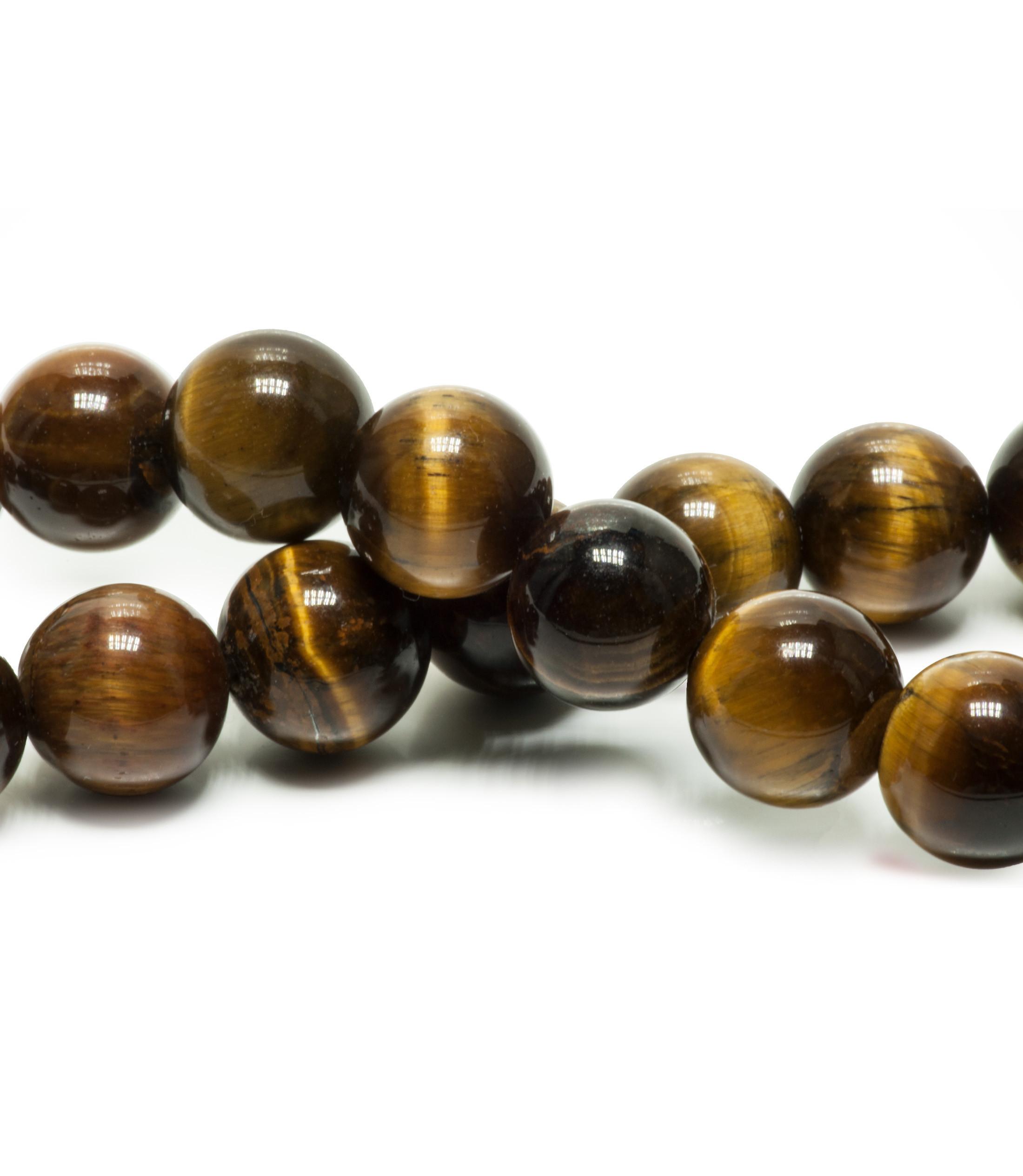
Tiger Eye is a golden-brown variety of quartz distinguished by its silky luster and chatoyant “cat’s-eye” effect. This optical shimmer, produced by parallel fibrous structures within the stone, gives the gem its name and visual resemblance to a tiger’s eye. It is prized in jewelry, carving, and ornamentation for its rich bands and dynamic light.
Key facts
- Chemical composition: Silicon dioxide (SiO₂)
- Mineral group: Quartz (silicate)
- Hardness: 6.5–7 on the Mohs scale
- Crystal system: Trigonal
- Primary sources: South Africa, Western Australia, Brazil, India, Namibia
Formation and structure
Tiger Eye forms when the fibrous blue mineral crocidolite (riebeckite asbestos) is replaced by silica through pseudomorphism. Iron oxides from the original fibers tint the quartz in golden to brown hues. The preserved alignment of the fibers acts as micro-reflectors, producing the shifting band of light known as chatoyancy when the stone or light moves across its surface.
Color varieties and relatives
The classic golden-brown type is most familiar, but heat or natural oxidation can deepen tones into red Tiger Eye (also called Bull’s Eye). The less-oxidized, blue-gray precursor is Hawk’s Eye, while Tiger Iron combines Tiger Eye with hematite and jasper in layered bands. These related materials share the same chatoyant structure and are often used together in decorative pieces.
Physical and optical properties
The gemstone exhibits a silky to vitreous luster and is opaque to translucent at thin edges. Its refractive index ranges near 1.54, and specific gravity about 2.64–2.71. When cut en cabochon—with the fibers oriented parallel to the base—the stone reveals a sharp, mobile eye line perpendicular to its fibrous pattern.
Occurrence and use
Major deposits lie in South Africa’s Northern Cape, Western Australia’s Pilbara region, and Brazil’s Minas Gerais, with smaller finds in India, China, and the United States. Owing to its durability and affordability, Tiger Eye is commonly fashioned into rings, beads, and carvings, often favored in men’s jewelry. High-quality specimens show intense golden color, strong chatoyancy, and minimal surface fractures.
Care and handling
With quartz hardness, Tiger Eye withstands everyday wear but should be protected from abrasive contact and harsh chemicals. Gentle cleaning with mild soap and water preserves its polish and fiber alignment, ensuring the distinctive “eye” continues to gleam across its surface.