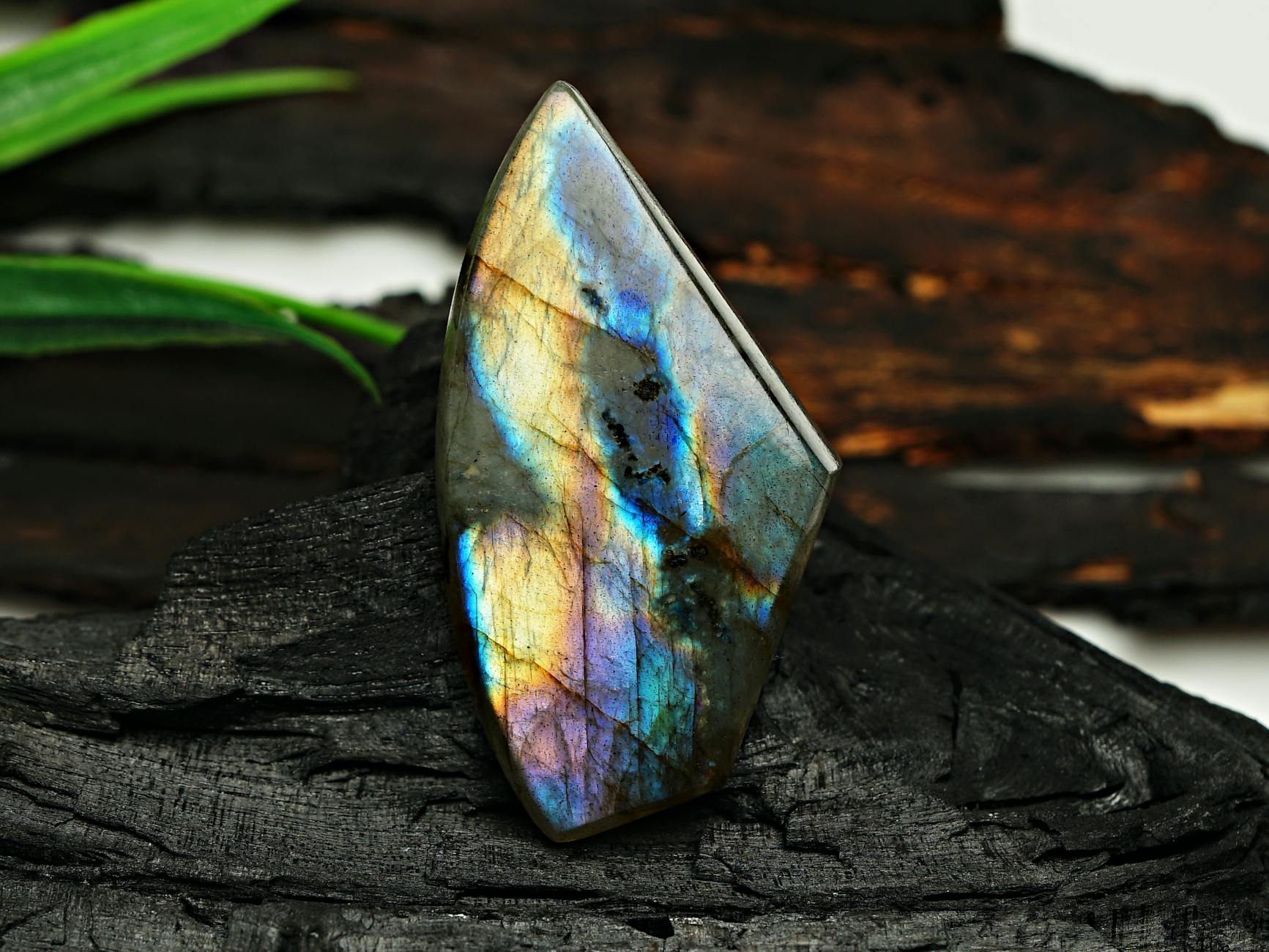
Labradorite is an iridescent variety of plagioclase feldspar prized for its optical effect known as labradorescence—broad flashes of blue, green, gold, and occasionally red or violet that appear when light strikes the stone at certain angles. First identified in the late 18th century on St. Paul’s Island, Labrador, Canada, it remains valued in both jewelry and decorative stonework for its vivid, aurora-like shimmer.
Key facts
- Chemical formula: (Ca,Na)(Al,Si)₄O₈
- Mineral group: Plagioclase feldspar (An₅₀–An₇₀)
- Crystal system: Triclinic
- Hardness: 6–6.5 (Mohs)
- Specific gravity: 2.68–2.72
- Optical phenomenon: Labradorescence (interference-based iridescence)
Structure and optical effect
Labradorite forms through slow cooling of mafic igneous rocks such as basalt, gabbro, and anorthosite. During cooling, microscopic lamellae of slightly different compositions—alternating sodium- and calcium-rich feldspar layers—develop inside the crystal. These nanoscale layers act as internal diffraction gratings: light waves reflecting between them interfere, strengthening specific wavelengths. The result is the directional, neon-like color play unique to labradorite. Stones are cut as cabochons with the base parallel to these layers to maximize the effect. (National Gem Lab)
Varieties and related stones
- Spectrolite: A Finnish variety from Ylämaa exhibiting a full-spectrum display with exceptional saturation.
- Andesine-labradorite: Intermediate composition with brown-to-red hues, sometimes diffusion-treated.
- Oregon Sunstone: Transparent labradorite containing copper inclusions that create metallic aventurescence rather than labradorescence.
- Rainbow Moonstone: Trade term for colorless to white labradorite showing blue sheen, distinct from true orthoclase moonstone. (Gem Rock Auctions)
Occurrence and sources
Major gem deposits occur in Canada (Labrador and Newfoundland), Madagascar, Finland, Norway, Russia, India, and parts of the United States such as Oregon and New York. Labradorite often occurs in large anorthosite bodies that can be quarried for architectural stone marketed as “blue granite” or “labradorite granite.” (Geology.com)
Use and care
Labradorite’s combination of moderate hardness and perfect cleavage requires careful handling in jewelry; protective mountings are recommended. Clean gently with warm water and mild soap, avoiding ultrasonic or steam systems. Its labradorescence is stable and does not fade, though surface polish may dull with abrasion. (Nobbier)
Labradorite’s interplay of physics and geology—ordinary feldspar transformed into a natural light show—makes it both a scientific curiosity and a perennial favorite among gem collectors and designers.